Updated on: October 13, 2026
Written by: Adel Galal, Founder and Lead Writer at NextFitLife
Zone 2 cardio for beginners should feel easy but purposeful. Your breathing is deeper than at rest, yet you can still speak in full sentences. You should finish feeling that you could keep going. If you are gasping, counting the minutes, or fighting your pace, you are probably working too hard.
That simple description is more useful for a beginner than chasing a perfect number on a smartwatch.
Heart rate can help, but Zone 2 is not one universal beats per minute range. Age formulas, watches, fitness level, heat, medicines, sleep, and the zone system being used can all change the number.
This article is for general information and education. It does not replace medical advice, diagnosis, or an individual exercise prescription.
For broader training guidance, visit the NextFitLife Fitness Hub, the Cardio and Endurance Guide, and the Fitness for Beginners Guide.
- What Zone 2 cardio means
- How easy Zone 2 should feel
- Why heart rate zones disagree
- 11 smart beginner rules
- Talk test and breathing
- Heart rate estimates
- Walking, cycling, and jogging
- Cardiac drift
- Zone 2 versus HIIT
- Zone 2 versus LISS
- Four week beginner plan
- Common mistakes
- Safety and medical advice
- References and Sources
- Internal Links + Hub
- Author Bio
- Frequently Asked Questions
What is Zone 2 cardio?
Zone 2 is easy aerobic exercise that you can sustain without building large amounts of fatigue.
In popular five zone fitness systems, it is the second lowest training zone. You may see it described as roughly 60 to 70 percent or 65 to 75 percent of estimated maximum heart rate.
Those numbers are useful as rough guides, but they are not the best definition.
A 2025 expert consensus placed Zone 2 immediately below the first ventilatory threshold or first lactate threshold. That is the point before breathing and lactate begin rising more sharply.
For an athlete in a laboratory, that threshold can be measured.
For a beginner walking outdoors, it does not need to be.
You can get surprisingly close using the talk test, breathing, and perceived effort.
Why do Zone 2 definitions look different online?
Because the word “zone” does not have one universal meaning.
A five zone smartwatch system might label easy aerobic work as Zone 2.
A research paper using a three zone model can call a different intensity Zone 2.
Some systems use percentage of maximum heart rate. Others use heart rate reserve, lactate, power, ventilatory thresholds, or pace.
This is why copying a number from somebody else's watch is a bad starting point.
For this article, Zone 2 means the easy aerobic intensity commonly used in five zone fitness systems and performed close to, but below, the first major physiological threshold.
How easy should Zone 2 cardio feel?
Easy enough that you could continue.
You should still feel like you are exercising. Your breathing will be deeper, your body may feel warm, and you may sweat.
But the effort should stay controlled.
| Clue | Good Zone 2 Feel | Probably Too Hard |
|---|---|---|
| Conversation | Full sentences are comfortable | Only a few words before breathing |
| Breathing | Deeper but controlled | Breathing dominates your attention |
| Legs | Working without strong burning | Burning and frequent slowdowns |
| Finish | You could continue | You are relieved the session is over |
11 smart rules for Zone 2 cardio for beginners
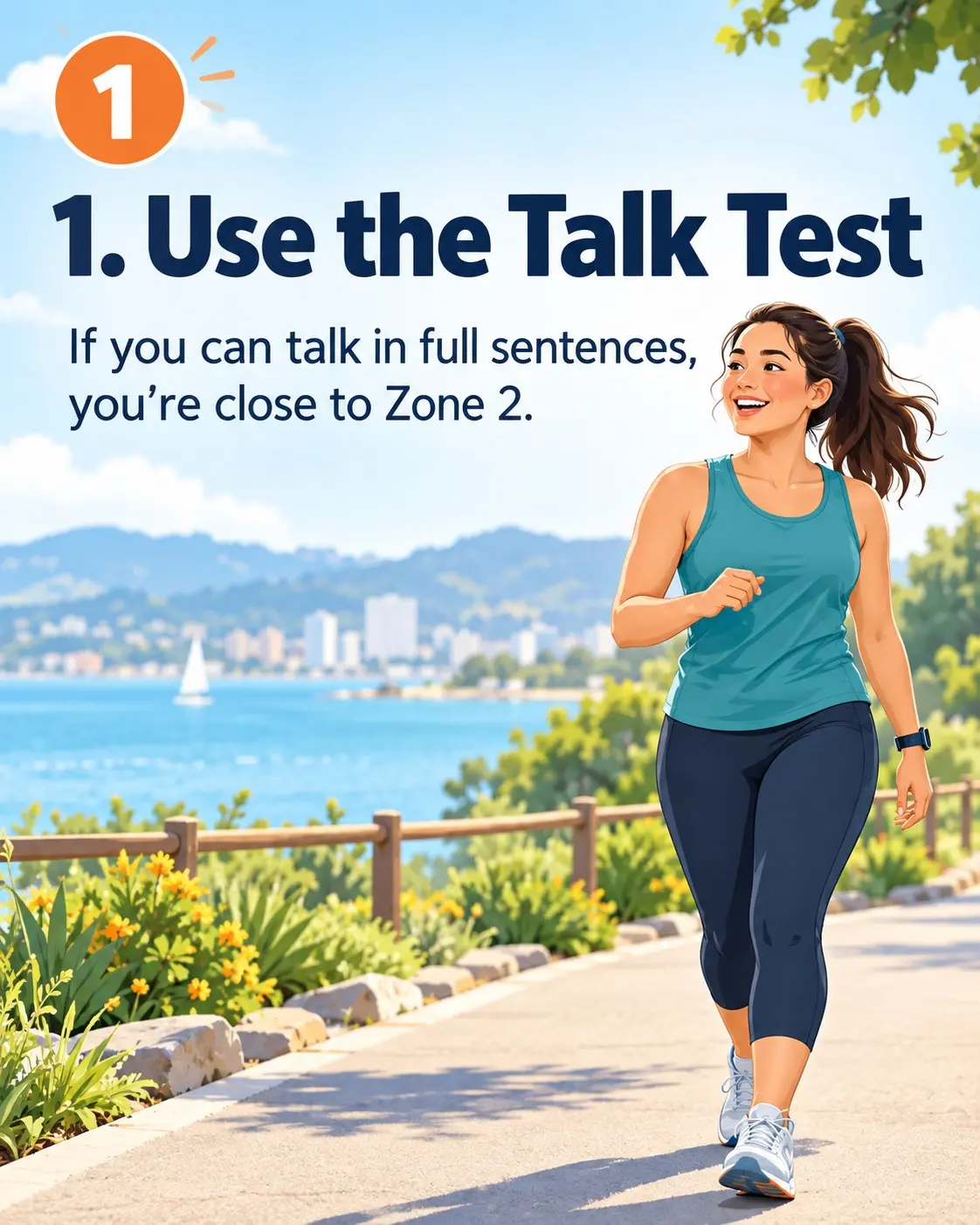
1. Learn the talk test before chasing heart rate
This is the first tool I would teach.
During your session, speak two or three normal sentences out loud.
If you can talk comfortably, your effort is probably in the right general range.
If you can sing without changing your breathing, you may be working below moderate intensity.
If you can say only a few words before needing a breath, slow down.
CDC describes moderate aerobic exercise in almost exactly this practical way: you can talk, but not sing. During vigorous activity, it becomes difficult to say more than a few words.
That is simple enough to use on a treadmill, bicycle, walking path, or elliptical.
2. Treat your watch as feedback, not authority
Your watch does not directly know your lactate threshold just because it knows your age.
Many devices estimate your maximum heart rate and then build zones from that estimate.
If the estimate is wrong, the zones can be shifted too.
Check what method your device uses before worrying about whether the screen says Zone 2 or Zone 3.
3. Use heart rate as a rough second check
A common five zone estimate places Zone 2 around 60 to 70 percent of estimated maximum heart rate.
Some systems use slightly different boundaries.
The American Heart Association gives a broader moderate intensity range of about 50 to 70 percent of estimated maximum heart rate.
These are averages, not personal test results.
4. Do not treat 220 minus age as your real maximum
The familiar formula is:
220 minus your age = estimated maximum heart rate
If you are 40:
220 minus 40 gives an estimated maximum of 180 beats per minute.
A rough 60 to 70 percent range would be about 108 to 126 beats per minute.
Useful?
Yes.
Exact?
No.
The American Heart Association describes age based numbers as averages and recommends treating them as a starting guide rather than a rule.
5. Walking counts
You do not need to jog for Zone 2 to count.
For many beginners, brisk walking is the best starting tool because speed and incline are easy to adjust.
CDC lists brisk walking among moderate intensity activities.
Good options include:
- Outdoor brisk walking
- Incline treadmill walking
- Stationary cycling
- Easy outdoor cycling
- Elliptical training
- Easy rowing
- Controlled swimming
The activity does not decide the zone.
Your effort does.
See Indoor Walking Exercise if walking is your preferred starting point.
6. Add incline before forcing yourself to run
This solves a common beginner problem.
Flat walking may feel too easy, while jogging immediately pushes breathing too high.
Use a small incline instead.
On a treadmill, add grade in small steps. Outside, use a gentle hill.
Cycling works the same way. Increase resistance a little rather than jumping to a hard effort.
The best Zone 2 activity gives you fine control over intensity.
7. Let perceived effort confirm the pace
Perceived exertion means how hard the exercise feels.
ACSM materials place moderate aerobic activity around 3 to 4 on one 0 to 10 effort scale, while other public health materials use somewhat different descriptors.
That difference is another reason not to obsess over one number.
The description matters more:
Controlled. Sustainable. Clearly exercise, but not hard exercise.
8. Expect heart rate to drift during longer sessions
You may start cycling at 125 beats per minute and later see 132 or 135 even though the bike resistance barely changed.
This is called cardiac drift or cardiovascular drift.
During prolonged exercise, heart rate can rise while stroke volume falls. Heat and dehydration can make this effect stronger.
A small gradual increase does not mean the workout suddenly failed.
If conversation stays easy and breathing remains controlled, look at the whole pattern rather than reacting to every beat.
If breathing clearly becomes harder too, ease off.
9. Start with shorter sessions
You do not need a 60- or 90-minute session in your first week.
If you are new to cardio, 20 minutes of steady work is enough to learn the pace.
Build duration before chasing speed.
This is especially important if your muscles, joints, or feet are not used to repetitive aerobic work.
10. Do not treat Zone 2 like a magic biological switch
Zone 2 has become fashionable because it is useful.
Useful does not mean uniquely superior.
A 2025 Sports Medicine review challenged claims that one narrow Zone 2 intensity is the best choice for mitochondrial development or cardiometabolic health in everyone.
The 2025 expert consensus also noted that many expected adaptations are not unique to Zone 2 and can occur at nearby intensities.
So yes, Zone 2 can build your aerobic base and improve cardiorespiratory fitness.
No, moving a few beats outside an estimated watch zone does not ruin the session.
11. Keep strength training in your week
Cardio is only one part of fitness.
WHO recommends 150 to 300 minutes of moderate aerobic activity each week for adults, or 75 to 150 minutes of vigorous activity, plus muscle strengthening on at least two days.
A beginner does not need to hit that full target immediately.
Build toward it.
For strength work, see Strength Training Exercises at Home for Beginners.
What heart rate should Zone 2 be?
If you want a number, start with a range and then check it against conversation and breathing.
The table below uses 60 to 70 percent of the familiar 220 minus age estimate.
It is a rough guide, not a personal prescription.
| Age | Estimated Max HR | Rough 60 to 70% Range |
|---|---|---|
| 20 | 200 bpm | 120 to 140 bpm |
| 30 | 190 bpm | 114 to 133 bpm |
| 40 | 180 bpm | 108 to 126 bpm |
| 50 | 170 bpm | 102 to 119 bpm |
| 60 | 160 bpm | 96 to 112 bpm |
| 70 | 150 bpm | 90 to 105 bpm |
If the number and your breathing disagree, do not assume the formula is right and your body is wrong.
What if your watch says Zone 3 but you can talk easily?
Check the watch settings first.
Many devices use an estimated maximum heart rate. Others use heart rate reserve or their own zone boundaries.
If the underlying maximum is wrong, every zone can be shifted.
If you are clearly exercising, speaking in full sentences, and not approaching a hard effort, one watch label should not make you panic.
Use the watch as one piece of information.
Is nasal breathing a good Zone 2 test?
It can be helpful, but I would not use it as the main rule.
Some people can nasal breathe at fairly high workloads.
Others have allergies, congestion, or anatomy that makes nasal breathing harder even at easy effort.
If nasal breathing helps you stay relaxed, use it.
The talk test is more useful for most beginners.
How do you know if Zone 2 is too easy?
Ask yourself three questions.
Is your breathing different from rest?
If not, add a little speed, incline, or resistance.
Could you sing comfortably?
If yes, you may be below the intended moderate range.
Does it feel like purposeful exercise?
If the effort feels exactly like wandering around a shop, raise it a little.
Very easy movement still has value.
It just may not be the Zone 2 session you planned.
How do you know if Zone 2 is too hard?
The signs are usually clearer.
- You can only speak in short phrases
- Your breathing becomes the main thing you notice
- Your legs begin burning
- You repeatedly need to slow down
- You keep checking how much time remains
- You cannot imagine holding the pace much longer
If this is happening, slow down.
Walking is allowed.
Can beginners walk for Zone 2 instead of running?
Absolutely.
For many people starting fitness, running is too intense to stay conversational.
Brisk walking, incline walking, or a run and walk approach works better.
A beginner might jog for two minutes, walk until breathing settles, then jog again.
As fitness improves, more of the same route may become runnable at the same easy effort.
That is real progress.
Zone 2 cardio versus LISS: are they the same?
They overlap, but they are not identical.
LISS means low-intensity steady-state cardio.
Zone 2 describes an intensity.
A steady conversational bike ride can be both.
An extremely slow recovery walk might be LISS but fall below your intended Zone 2 effort.
Read LISS Cardio for a full comparison.
Is Zone 2 better than HIIT?
No single winner exists.
Zone 2 is easier to recover from and makes it practical to accumulate more aerobic training volume.
High intensity interval training uses much harder efforts and can improve fitness efficiently.
The 2025 review questioning Zone 2 hype points out that high intensity training also produces strong mitochondrial and cardiometabolic adaptations.
A balanced program can use both.
A beginner does not need both immediately.
First build consistency and learn easy cardio. Hard intervals can come later.
Does Zone 2 burn more fat?
Your body uses a mixture of fat and carbohydrate during exercise.
At lower intensities, a larger proportion of energy can come from fat than during harder work.
This is where the “fat burning zone” idea comes from.
That does not mean Zone 2 automatically creates more body fat loss.
Long-term weight change depends on total energy balance, diet, physical activity, training, sleep, and consistency.
Zone 2 is useful because it is repeatable and creates manageable fatigue.
It is not a shortcut around nutrition.
See Does Walking Burn Belly Fat? for more context.
Do you need a heart rate monitor?
No.
You can train Zone 2 using conversation, breathing, and perceived effort.
A monitor becomes useful if you enjoy data or want to track changes over time.
For a beginner doing a 30 minute walk, perfect heart rate precision is not necessary.
If you later train seriously for endurance performance, more accurate heart rate, pace, power, or threshold testing becomes more useful.
For heart rate basics, read the NextFitLife Heart Rate Guide.
What is heart rate drift during Zone 2?
Cardiac drift means heart rate gradually rises during prolonged steady exercise even though your external workload changes little.
Research describes cardiovascular drift as a rise in heart rate alongside a fall in stroke volume during prolonged exercise.
Heat and dehydration can increase the effect.
This is one reason a fixed heart rate ceiling can become frustrating during longer sessions.
If effort and breathing rise along with the heart rate, slow down.
If the heart rate rises modestly but conversation and perceived effort remain stable, look at the full picture.
How long should Zone 2 cardio last for a beginner?
Twenty to 30 minutes is a good place to start for many healthy beginners.
You can build from there as your fitness and comfort improve.
Do not compare your first month with an endurance athlete doing several hours.
Your first goal is consistency.
A simple 4-week Zone 2 plan for beginners
| Week | Sessions | Main Work | Goal |
|---|---|---|---|
| 1 | 2 to 3 | 20 minutes | Learn the conversational pace |
| 2 | 3 | 25 minutes | Keep effort steady |
| 3 | 3 | 30 minutes | Build duration without raising effort |
| 4 | 3 | Two at 30 minutes, one at 35 to 40 minutes | Extend only if recovery feels good |
This is a practical beginner example, not a medical prescription.
Add a five minute gentle warm up before the main work and a short easy cooldown afterward.
What should a beginner week look like with strength training?
You do not need cardio every day.
| Day | Example |
|---|---|
| Monday | 30 minute Zone 2 session |
| Tuesday | Strength training |
| Wednesday | Rest or gentle walking |
| Thursday | 30 minute Zone 2 session |
| Friday | Strength training |
| Saturday | 30 to 40 minute Zone 2 session |
| Sunday | Rest or recreational movement |
WHO recommends aerobic activity plus strength work on at least two days each week for adults.
The exact weekly structure can change with your goals.
How fast should your Zone 2 pace improve?
Do not expect a dramatic change every week.
Weather, sleep, stress, terrain, hydration, and fatigue all change pace and heart rate.
Look for trends instead.
Good signs include:
- The same route feels easier
- You walk or cycle faster at the same breathing effort
- Your heart rate is lower at the same comfortable pace
- You can stay conversational for longer
- You recover more easily afterward
Those changes matter more than one unusually good workout.
Seven Zone 2 mistakes beginners make
1. Going too hard
This is the classic error.
If every session leaves you exhausted, you are not building the easy side of your training very well.
2. Obsessing over a single heart rate formula
Your calculated range is an estimate.
Use breathing and conversation too.
3. Running when walking works better
You do not earn extra points for jogging.
Use the modality that keeps effort controlled.
4. Making the first sessions too long
Build gradually.
Fitness grows when training is repeatable.
5. Ignoring strength training
Aerobic endurance and muscular strength are different qualities.
Train both.
6. Believing Zone 2 is uniquely magical
Zone 2 is useful because it is sustainable and produces relatively low fatigue.
It is not the only intensity that improves fitness or mitochondrial adaptations.
7. Letting the watch overrule obvious body signals
A device is a tool.
Your breathing, symptoms, recovery, and conversation still matter.
Is Zone 2 safe for everyone?
Moderate aerobic activity is appropriate for most healthy adults.
Some people need individual guidance.
Speak with a qualified healthcare professional before making major exercise changes if you have a significant heart, lung, metabolic, neurological, or other chronic condition that limits exercise.
Heart rate-based zones also become less reliable when medicines alter heart rate response.
Stop exercise and seek medical assessment for concerning symptoms such as:
- Chest pressure or significant chest pain
- Fainting or near fainting
- Severe unusual shortness of breath
- A new fast or irregular heartbeat with symptoms
- Sudden weakness or neurological symptoms
Do not use an estimated Zone 2 number to explain away alarming symptoms.
Conclusion: learn the feeling before chasing the number
The most useful lesson about zone 2 cardio for beginners is that easy cardio should actually feel easy.
You should be working, but conversation should still be comfortable. Heart rate can help confirm the pace, yet it should not control every second of the session.
Your next step: choose walking, cycling, or another simple activity and do 20 to 30 minutes at a conversational pace. Check your breathing first and your watch second. Repeat that consistently before worrying about perfect zones.
References and Sources
- Centers for Disease Control and Prevention. How to Measure Physical Activity Intensity. Updated December 4, 2025.
Used for the talk test, moderate versus vigorous intensity, and practical exercise examples.
https://www.cdc.gov/physical-activity-basics/measuring/index.html - World Health Organization. Physical Activity.
Used for adult weekly aerobic activity and muscle strengthening recommendations.
https://www.who.int/europe/news-room/fact-sheets/item/physical-activity - American Heart Association. Exercise and Physical Activity.
Used for estimated maximum heart rate and moderate intensity heart rate guidance.
https://www.heart.org/en/healthy-living/exercise-and-physical-activity/ - American College of Sports Medicine. Tips for Monitoring Aerobic Exercise Intensity.
Used for heart rate, perceived effort, and conversation-based intensity guidance.
https://www.acsm.org/docs/default-source/files-for-resource-library/exercise-intensity-infographic.pdf - Stöggl T, et al. What Is Zone 2 Training? Experts' Viewpoint on Definition, Training Methods, and Expected Adaptations. 2025.
Used for the current expert definition around the first lactate or ventilatory threshold and the point that adaptations are not unique to one narrow zone.
https://pubmed.ncbi.nlm.nih.gov/40010355/ - Storoschuk KL, et al. Much Ado About Zone 2: A Narrative Review Assessing the Efficacy of Zone 2 Training for Improving Mitochondrial Capacity and Cardiorespiratory Fitness in the General Population. Sports Medicine. 2025.
Used for the section challenging claims that Zone 2 is uniquely optimal for health and mitochondrial adaptation.
https://pubmed.ncbi.nlm.nih.gov/40560504/ - Wingo JE, Ganio MS, Cureton KJ. Cardiovascular Drift During Heat Stress: Implications for Exercise Prescription.
Used for heart rate drift during prolonged exercise and the influence of heat.
https://pubmed.ncbi.nlm.nih.gov/22410803/ - Coyle EF. Cardiovascular Drift During Prolonged Exercise and the Effects of Dehydration.
Used for the role of hydration and prolonged exercise in heart rate drift.
https://pubmed.ncbi.nlm.nih.gov/9694416/
Internal Links + Hub
Author Bio
Adel Galal is the founder and lead writer of NextFitLife. His fitness and wellness content focuses on turning established exercise science and public health guidance into clear information readers can use in everyday training.
For this article, the focus is on making zone 2 cardio for beginners practical without turning one heart rate formula or smartwatch zone into a false rule.
I am not a dermatologist or a doctor, and this content does not replace professional medical advice. What I share comes from real-life experience, extensive research, and consultation with healthcare providers. Always consult qualified medical professionals for diagnosis and treatment of any health condition.
This article has not been medically reviewed by a physician, exercise physiologist, physical therapist, cardiologist, or other licensed healthcare professional.
Learn more about NextFitLife and its editorial approach at About Us.
Frequently Asked Questions
What is Zone 2 cardio for beginners?
Zone 2 cardio for beginners is easy aerobic exercise that feels controlled and sustainable. Breathing is deeper than at rest, but you should still be able to speak in full sentences without gasping.
How easy should Zone 2 cardio feel?
It should feel easy to moderate rather than hard. You should feel that you are exercising, but your breathing should remain controlled, and you should finish knowing you could continue longer.
What heart rate is Zone 2?
Popular five zone systems often place Zone 2 near 60 to 70 percent or 65 to 75 percent of maximum heart rate. Exact boundaries vary, so use heart rate together with conversation and perceived effort rather than relying on one number.
What is the talk test for Zone 2?
The talk test means checking whether you can speak comfortably during exercise. CDC says moderate intensity usually allows talking but not singing, while vigorous activity makes speaking more than a few words difficult.
Can walking be Zone 2 cardio?
Yes. Brisk walking or incline walking can be Zone 2 for many beginners. The correct activity is the one that produces the desired effort, not the one that looks hardest.
Should beginners run for Zone 2?
Not necessarily. If jogging makes conversation difficult, walking or using a run-and-walk pattern is a better way to keep the session easy.
How long should a beginner do Zone 2?
About 20 to 30 minutes is a practical starting point for many healthy beginners. Duration can gradually increase as fitness, comfort, and recovery improve.
How many Zone 2 sessions should a beginner do each week?
Two or three sessions per week is a practical starting point. You can build from there while also leaving room for strength training and recovery.
Is Zone 2 the same as LISS?
They overlap but are not identical. LISS describes steady low intensity exercise, while Zone 2 refers to an intensity range. A steady Zone 2 walk or bike ride can be both.
Is Zone 2 better than HIIT?
No. Zone 2 allows more easy aerobic volume with less fatigue, while HIIT uses short hard efforts and can improve fitness efficiently. A complete program can use both depending on experience and goals.
Does Zone 2 burn belly fat?
Zone 2 uses a relatively high proportion of fat as fuel compared with harder exercise, but that does not guarantee more body fat loss. Long-term fat loss depends on total energy balance, diet, activity, and consistency.
Why does my heart rate rise during a steady Zone 2 workout?
Heart rate can gradually rise during prolonged exercise because of cardiovascular drift. Heat and dehydration can make this effect stronger, so use breathing and perceived effort alongside heart rate.
Do I need a heart rate monitor for Zone 2?
No. Beginners can use conversation, breathing, and perceived effort. A monitor is useful for tracking data but is not required to perform effective easy aerobic training.
Why does my watch show Zone 3 when the effort feels easy?
Your device may use a different zone system or an inaccurate estimated maximum heart rate. Check its settings and use conversation and breathing as additional evidence before assuming the workout is too hard.
Is Zone 2 training uniquely best for mitochondria?
Current evidence does not show that one narrow Zone 2 intensity is uniquely best for mitochondrial adaptation. A 2025 review found strong evidence that other intensities, including harder exercise, can also improve mitochondrial and cardiometabolic fitness.

Health & wellness writer with 30+ years of experience in nutrition, fitness, and healthy aging. Founder of NextFitLife.com — evidence-based health guidance.